

When we talk about fashion, we often think of runways, new collections, or pieces starting to pop up on the streets. But fashion can also be found in something much older: the way a community dresses, styles its garments, and works with textiles. In Peru, vibrant colors, handmade weaves, blankets, and accessories are all part of a living history that can still be seen across different regions of the country. A garment might catch your eye because of its design, but it can also tell us a lot about who made it and where it comes from.
Traditional Peruvian clothing brings together diverse styles of dress that have evolved across different communities and eras. There isn’t just one single outfit that represents the entirety of Peru. Some pieces are worn for celebrations, others are part of daily life, and certain designs even help identify specific communities. In this article, we’ll explore how traditional attire connects with identity, which garments stand out in the Andes, what lies behind their colors and weaves, and how these traditional styles continue to thrive in modern-day Peru.

Traditional clothing as an expression of identity
A garment can function as a calling card. In different Andean communities, textiles are part of identity and can help distinguish one group from another. The Ministry of Culture points out that, for Quechua peoples, textiles hold special importance because they are not only the foundation of their clothing, but also a key element for differentiating between communities. This gives a piece of clothing a value that goes far beyond its appearance.
The timing of when it’s worn matters, too. In many Quechua communities, certain garments that were once used on a regular basis are now reserved solely for festivals or ritual moments. The design we see is inseparable from the occasion. A garment can change depending on the place, the celebration, and the person wearing it. From a fashion perspective, this is fascinating because it shows that clothing can also act as a way to communicate belonging.
What traditional Andean clothing is like
Andean clothing has a feature that makes it easy to recognize: it blends protection, color, and design. The climate in the highlands means many garments serve a practical purpose, but that doesn’t mean they’re plain. Ponchos, blankets, hats, and sashes can combine different weaves and colors, creating outfits that vary quite a bit from one community to another. The way people dress also responds to the environment where each group lives.
The clothing we know today is the result of a long history and various influences. The Ministry of Culture explains that certain Spanish-origin garments, such as full skirts (polleras) and ponchos, were incorporated and adapted to the traditional practices of Quechua peoples. Because of this, it wouldn’t be accurate to speak of a single ‘Andean outfit.’ There are shared elements, but each community can have its own shapes, combinations, and details.
You might also want to check out: Top 10 Outdoor adventures in South America
Traditional clothing for women
Among women’s garments, we find the pollera skirt and the lliclla shawl, along with various head coverings. The pollera can stand out for its vibrant colors, embroidery, and volume, while the lliclla is worn over the shoulders and may feature distinct designs unique to each community. There are also traditional hats (monteras) and other accessories whose shapes vary by region. The final look can appear very different even when wearing garments with similar names.
The way these pieces are styled is also part of each community’s unique style. During a celebration, a woman might wear multiple garments and accessories that she doesn’t necessarily use the same way every day. In Ocongate, Cusco, for example, MINCETUR documents the crafting of llicllas, monteras, polleras, and other textile pieces using traditional techniques. This shows that the exact same garment can serve practical, cultural, and aesthetic functions.
Traditional clothing for men
Among men’s garments, the poncho, the chullo hat, the chumpi belt, and the chuspa bag stand out. The poncho can vary in color and design; the chumpi is a woven belt worn around the waist, and the chuspa is a small pouch. The chullo is known for its earflaps and the wide variety of patterns it can feature. These pieces are not worn in the exact same way across all communities, so their shapes and combinations can change depending on the location.
From a fashion perspective, the chullo combines functionality and design into a single piece. It protects against the cold, but it can also communicate information through its colors and patterns. PROMPERÚ points out that, in Taquile, its designs can indicate the age and social status of the men. An apparently simple garment can become a visual element that communicates much more than meets the eye.
Colors and designs that tell stories
Colors are one of the first elements that catch our attention when we look at traditional Peruvian textiles. There are very vibrant combinations, sharp contrasts, and patterns that make a garment stand out even from a distance. Animals, plants, geometric shapes, mountains, and other elements related to the environment may appear. There is no single palette that represents the entirety of Peru. Each community can develop its own color combinations and ways of decorating its garments.
The designs can have a direct connection to the lives of those who make them. In Ccatcca, Cusco, MINCETUR documents textiles featuring symbols tied to Andean worldview, agricultural cycles, communal identity, and the relationship with Pachamama. This changes how we look at a garment: a pattern stops being merely decorative and can become a part of the community’s history.
How traditional textiles are made
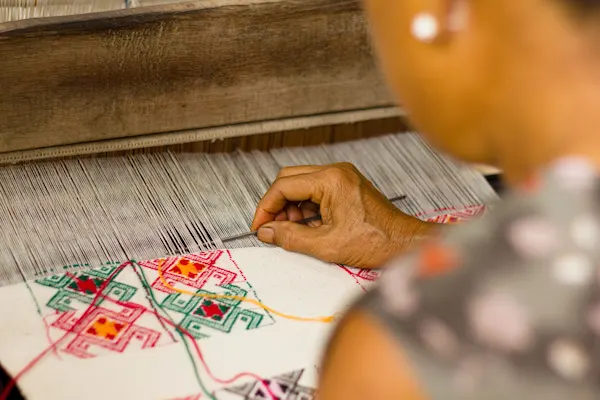
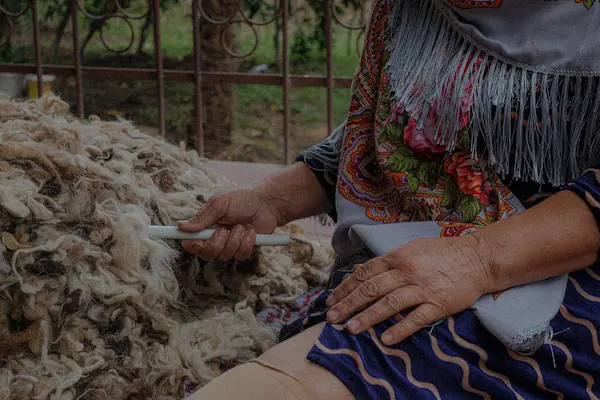
A handwoven garment doesn’t just appear out of nowhere. Before weaving even begins, the fibers must be prepared, turned into yarn, and a decision must be made on how each piece will be worked. In communities like Ccatcca and Ocongate, natural fibers such as alpaca and sheep’s wool are used. Some are kept in their natural color, while others are dyed with various materials before the weaving process starts.
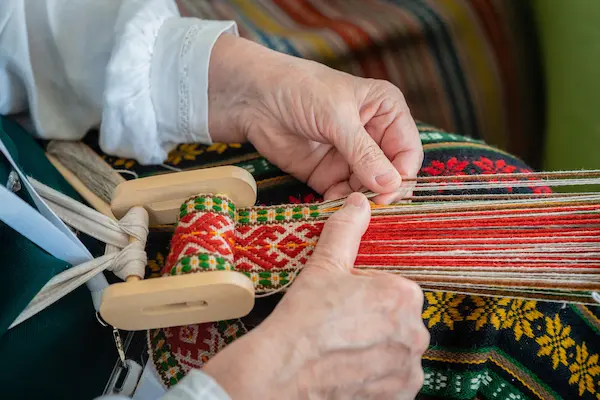
Then comes a part that we often don’t see when admiring a finished garment: the weaving itself. Quechua communities preserve techniques like the backstrap loom and the horizontal loom. In Ccatcca, the stake loom is also used. All of this work requires practice and knowledge, meaning behind every piece there is much more than just a good design. There is also a technique that has been learned and passed down within the community.
Materials that shape each garment
Natural fibers play an important role in Andean textiles. The Ministry of Culture mentions the use of cotton and the wool of camelids and sheep among Quechua peoples. In Ccatcca, alpaca and sheep’s wool are used to craft llicllas, ponchos, sashes, chullos, blankets, and bags. Each material has its own characteristics and can influence the final outcome of the piece.
Color can also originate from the raw material itself or be achieved through dyes. In Ccatcca, natural colorants obtained from elements such as cochineal, q’olle, chillka, walnut, and molle are documented. The process requires knowing which material to use and how to achieve the desired tone. It’s yet another example of how the aesthetics of these garments also depend on the knowledge behind them.
Techniques that keep the tradition alive
Traditional weaving doesn’t rely solely on materials. It also requires techniques that turn yarn into a complete piece. Backstrap looms and horizontal looms are part of the textile practices that the Ministry of Culture identifies among Quechua peoples.
What’s most interesting is that this knowledge doesn’t stop with a single generation. In Ccatcca, MINCETUR describes the transmission of these practices as knowledge passed down from generation to generation. Taquile offers another example: UNESCO notes that the community even has a specialized school to learn its textile craft. Tradition changes and can incorporate new symbols, but the techniques remain present.

Taquile: When weaving also communicates
The island of Taquile in Lake Titicaca is one of the best examples for understanding that a textile can be much more than just a garment. UNESCO added its textile art to the Representative List of the Intangible Cultural Heritage of Humanity in 2008. There, men and women of different ages participate in textile production, and the garments are an integral part of community life. The tradition brings together elements from ancient Andean cultures while continuing to incorporate modern imagery and symbols.
One of its best-known elements is the calendar belt, a woven piece that represents cycles related to agricultural and ritual activities. The chullo also stands out, as its designs can convey information about the age and social status of the men. From a fashion perspective, it is a uniquely interesting example because it demonstrates that a garment can possess design, identity, and meaning all at once.
Traditional clothing in modern-day Peru
Traditional clothing continues to be a part of life in various Peruvian communities. In some places, it is worn especially for festivals, celebrations, and important events. In others, certain garments still maintain a presence in daily activities. This means we are not solely talking about clothing that belongs to the past. Some of these pieces are still worn by the very communities that preserve their crafting techniques.
Tradition doesn’t mean everything has to stay the same, either. Furthermore, tourism has also influenced production and the community’s economy. Traditional clothing can adapt to new contexts and continue to hold cultural value, as long as the knowledge and practices that sustain it remain alive.
Discovering Peru through its clothing
Learning about traditional clothing allows you to look at Peru from a different perspective. A traveler might spot a pollera by its colors, pause to observe a chullo, or take an interest in a handwoven blanket. But behind every piece there is something more: a community, a technique, and a history. That is what makes traditional fashion also a way to connect with Peruvian culture.
For those traveling through Peru, discovering these textiles can become an experience that goes far beyond buying a souvenir. Observing how a fiber is prepared, discovering how a pattern is created, or meeting the people who keep these techniques alive helps you better understand what lies behind a garment. Traditional Peruvian clothing is not just a way of dressing. It is a way of showcasing identity, creativity, and a tradition that still has a great story to tell.